
Insurance Agent Onboarding Checklist (2026 Step-by-Step Guide)
By David Buckley, General Manager of Operations at CoTé Software & Solutions | Virsaic™ | LinkedIn
David Buckley is General Manager, Operations at AgencyMate, an integrated insurance agency management platform designed by agents, for agents. With experience supporting U.S. insurance agencies in automation and compliance workflows, David specializes in helping agencies reduce admin and increase sales performance

Quick Answer: What Is an Insurance Agent Onboarding Checklist?
An insurance agent onboarding checklist is a structured, step-by-step framework with clear steps outlined for each stage that insurance agencies use to integrate new agents into their business. Key components include HR paperwork, license verification, system account setup, carrier appointments, goal setting, and training materials. It ensures licensing compliance, system setup, sales workflow training, and performance goal alignment within the first 30, 60, and 90 days. Agents must also be officially appointed by each carrier before they can sell or discuss specific plans – this is a legal requirement that must be completed before client-facing work begins.
TL;DR – The 2026 Modern Onboarding Framework
Getting agent onboarding right from the very beginning is one of the most critical decisions an insurance company can make. Done well, an effective onboarding process accelerates time to first sale, improves agent retention, and positions your agency to serve clients with confidence from day one. Done poorly, it burns through your team’s resources, stalls new agent productivity, and creates documentation gaps that can expose you during an E&O audit. Here is the complete 2026 framework at a glance:
-
Verify licensing, NPN, and E&O coverage before the agent starts
-
Complete all HR paperwork and compliance setup on day one
-
Configure your AMS, CRM, email, and quoting tools during the first week
-
Assign a mentor and define 30/60/90-day performance goals early
-
Automate lead routing and renewal workflows to remove manual admin from the process
-
Track the KPIs that matter – time to first quote, first sale, and pipeline value
A complete insurance agent onboarding checklist in 2026 includes five essential pillars: compliance verification, technology setup, structured sales workflow training, mentorship, and measurable performance goals. Insurance agencies should verify licensing and E&O coverage, configure AMS and CRM systems, assign automated lead distribution, define 30/60/90-day benchmarks, and implement compliance audit tracking. Modern onboarding increasingly relies on technology to streamline administrative tasks, eliminate double data entry, and accelerate time to first sale. Organizations that standardize the process see improved agent retention, stronger compliance controls, and faster productivity ramp-up.
Insurance Agent Onboarding Checklist (Step-by-Step)
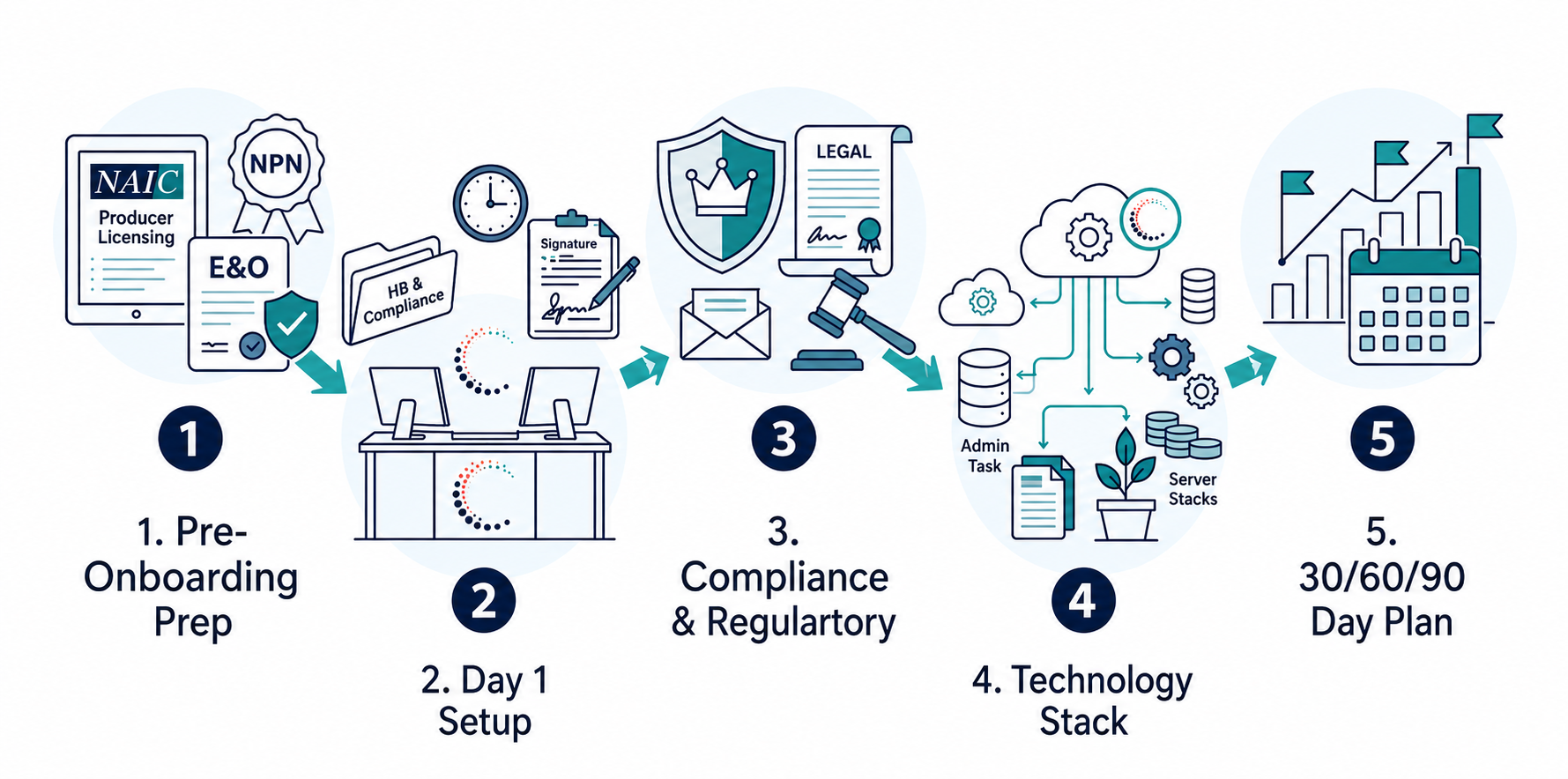
Phase 1 – Pre-Onboarding Preparation
The work that happens before an agent’s first day determines how efficient and smooth everything else is. From the beginning, prepare the right tools, training materials, and resources so new agents can hit the ground running. Start by verifying the agent’s state licenses and National Producer Number (NPN) through the NAIC Producer Licensing portal. Confirm their active Errors and Omissions (E&O) coverage is in place – this is not optional and should be documented before the agent interacts with any clients. Then work through the following:
-
Complete any required background checks as part of the hiring process
-
Prepare employment agreements and a customized compensation plan
-
Assign an onboarding mentor from your existing team
-
Prepare a digital welcome package and SOP playbook with training materials
-
Set up necessary user accounts and access to software tools
Handing a new agent a welcome package and a mentor on day one sends a clear signal: your agency has a system, not just good intentions.
Phase 2 – Day 1 Setup
Day one is about access, not training. The goal is to have every system configured and ready before the agent needs it – not after. A complete day one account setup ensures new agents can integrate into the team immediately and focus on productive work from the start. Work through:
-
Configure email and agency communication tools
-
Set up AMS access with appropriate permission levels
-
Connect CRM and marketing automation so the agent sees the full leads pipeline from day one
-
Enable eSignature and document workflows
-
Introduce carrier portals and quoting platforms so agents can begin to sell as soon as they are appointed
-
Walk through agency mission, workflow standards, and expectations in a single session
The goal is to have prospective agents and new hires productive within their first week – not still waiting for system access in week three.
Phase 3 – Compliance and Regulatory Setup
Compliance is not a one-time task – it is an ongoing responsibility that needs to be embedded from the beginning. This stage is critical for protecting both the agency and the agents it employs. In this phase:
-
Confirm CE requirements and renewal timelines specific to the agent’s state
-
Confirm the agent is officially appointed by each carrier for the lines of business they will sell – being appointed is a legal requirement and must be completed before the agent can discuss or promote those plans
-
Review your agency’s PII security protocols
-
Train on documentation audit trails from day one
-
Log all client communications for E&O compliance – establish this habit before an incident, not after
-
Cover commission reporting transparency to set clear expectations early
Phase 4 – Technology Stack Configuration
The right technology stack removes the complex manual overhead that slows new agents down and creates the errors that expose agencies to compliance risk. Access to the right tools at the right stage of onboarding is what separates efficient, high-growth agencies from those that struggle to scale. In 2026, a complete insurance agency technology setup includes:
-
AMS configuration for policy and client management, including carrier settings and licensed states
-
CRM integration to track leads, follow-up sequences, and client communication history
-
Lead capture form routing so new inquiries reach the right agent automatically
-
Automated renewal alerts so no policy lapses without a touchpoint
-
Performance dashboards visible to both the agent and the board or agency leadership
-
Commission tracking that does not require a spreadsheet to reconcile
It is worth noting that not all platforms are equal in setup complexity. Some AMS providers require weeks of mandatory training before an agent can access core features. If your agency is growing and needs new agents productive quickly, platform speed and ease of use should be a primary evaluation criterion – not an afterthought. Innovation in cloud-based onboarding solutions means the best platforms today offer instant access to features and built-in support resources with minimal input required from your team.
Phase 5 – 30/60/90-Day Performance Plan
Structured goals with a clear timeline separate agencies that develop great agents from those that lose them within six months. This is the stage where customized plans create real competitive advantage – not a generic response to onboarding, but a framework built around your agency’s business model and the lines your agents will sell.
First 30 Days
-
Complete product and carrier training using prepared training materials
-
Run at least 10 quoting simulations to build confidence and speed
-
Shadow senior agent calls to absorb real sales process
Day 60
-
Complete first independent policy bind and begin to serve clients directly
-
Establish a pipeline target with clear revenue milestones
-
Begin weekly KPI reviews to track progress and succeed against targets
Day 90
-
Achieve revenue target
-
Review retention and renewal strategy
-
Complete formal performance evaluation
This is not a rigid script – it is a framework insurance agencies can customize to their own business model and product mix.
Manual vs Automated Insurance Agent Onboarding

The difference between manual and automated onboarding is not just efficiency – it is the speed at which a new agent generates revenue for your agency. For companies that want to scale, the ability to automate and streamline the onboarding process is a direct growth lever.
|
Component |
Manual Onboarding | Automated Onboarding | With AgencyMate |
|---|---|---|---|
| Data Entry | Multiple systems, duplicate entry | Single data capture | One platform – no double entry |
| Lead Routing | Manual assignment | Auto-allocation |
Automated from lead capture |
| Compliance Logs | Manual tracking | Auto audit trail | Built-in E&O documentation |
| KPI Visibility | Spreadsheet tracking | Real-time dashboards | Built-in E&O documentation |
| Time to First Sale | Slower ramp-up | Accelerated | Selling within days, not weeks |
| Setup Time | Days to weeks | Varies by platform | Configured in days, no training program required |
AgencyMate is designed to get new agents operational fast. There are no mandatory training programs to complete before an agent can access the platform, no expensive implementation fees, and no weeks spent waiting for a consultant to configure your system. Most agencies are up and running within days of signing on – and when support is needed, you get a responsive, direct line rather than a ticket queue.
Management and Workflow Features That Improve Agent Retention

Onboarding does not end on day 90 – it transitions into an ongoing management cadence that determines whether agents stay and grow or leave within 12 months. Everyone involved in the process – mentors, managers, and new agents alike – plays a critical role in making that transition succeed.
Effective mentorship and feedback loops are the most consistent retention driver in the insurance industry. Weekly check-ins with a clear structure, transparent goal tracking, and constructive feedback cycles create the kind of environment where new agents feel supported rather than abandoned. Regular check-ins also allow the team to respond quickly when challenges arise, keeping agents on track and productive.
On the workflow side, standardized sales processes are equally essential. Automated follow-ups ensure no leads fall through the cracks, renewal reminders keep retention rates high without requiring manual calendar management, and task reminders keep agents focused on revenue-generating activity. A consistent quoting process also reduces errors and builds confidence faster than ad hoc approaches.
Technology Requirements for 2026 Agencies

The technology stack that supports a modern insurance agency onboarding process has five core components. An integrated AMS and CRM eliminates the dual-system data entry that creates errors and wastes agent time – the AMS should also manage carrier relationships, licensed states, and carrier appointments to ensure agents are properly set up and appointed before client-facing work begins. Smart document automation handles eSignature, policy documents, and client communications without manual intervention. AI-driven workflow management routes leads, assigns tasks, and triggers reminders based on policy status and client behavior. Digital signature capability is now standard across the US insurance market and expected by clients. Performance reporting by product and agent gives leadership the visibility they need to coach effectively and identify issues before they become attrition risks.
Decision Framework – Should You Automate Onboarding?

The right approach depends on your agency’s size and growth stage, but the direction of travel is clear. A well-structured hiring process and onboarding system gives insurance agencies a measurable advantage in agent retention, productivity, and speed to revenue.
Small agencies running a tight manual process with a stable headcount benefit from a structured checklist with steps outlined clearly for each stage as a strong foundation.
Growing agencies adding agents regularly and managing increasing client volume need an integrated AMS with workflow automation – not as a luxury, but as the infrastructure that makes growth sustainable and scalable.
Multi-location agencies coordinating across teams should be running full lifecycle automation with reporting dashboards as the standard, tracking performance at every stage across the entire organization.
One question worth asking regardless of your stage: if your agency needs to onboard a new agent and have them selling within a week, can your current technology stack support that? Platforms that require weeks of mandatory training before agents can access core features are a structural constraint on your agency’s growth velocity – not just an inconvenience.
Frequently Asked Questions
What should be included in an insurance agent onboarding checklist?
A complete checklist should cover five essential areas with clear steps outlined for each: licensing and compliance verification (state licenses, NPN, E&O coverage), HR paperwork and employment documentation, technology account setup (AMS, CRM, quoting tools, carrier portals), sales workflow training with structured 30/60/90-day goals, and KPI tracking to measure productivity and pipeline development from day one.
How long should insurance agent onboarding take?
An effective onboarding process typically spans 90 days, following a clear timeline with structured milestones: foundational setup and training in the first 30 days, first independent policy bind and pipeline development through day 60, and a full performance evaluation at day 90. Technology setup should be complete within the first week. If your platform requires weeks of configuration before an agent can work, that is a platform problem – not an onboarding problem.
What compliance requirements apply to new insurance agents?
New insurance agents must hold active state licenses for every line of business they will sell, maintain a valid NPN registered with the NAIC, carry active E&O insurance, and comply with continuing education requirements specific to their state. In addition, agents must be officially appointed by each carrier before they are legally permitted to discuss or promote that carrier’s plans. Insurance agencies are responsible for verifying all credentials before the agent works with clients and maintaining documentation audit trails for E&O purposes.
How do you verify an agent’s NPN?
You can verify a National Producer Number through the NAIC Producer Licensing resource center. The lookup is free and confirms active license status, lines of authority, state appointments, and whether the agent is officially appointed by a given carrier in each state.
Why is E&O insurance required during onboarding?
Errors and Omissions (E&O) insurance protects the agency and agent against claims arising from professional mistakes or omissions in the advice or coverage they provide. Without active E&O coverage, a single client complaint can create significant financial and reputational exposure for your business. Confirming E&O coverage before an agent interacts with any clients is a non-negotiable step. For background, see the Wikipedia overview of E&O insurance.
What is the difference between AMS and CRM in onboarding?
An Agency Management System (AMS) manages the policy lifecycle – applications, endorsements, renewals, carrier communications, and compliance documentation. A CRM manages the client relationship and sales pipeline – lead tracking, follow-up sequences, communication history, and deal progression. Both are required for a fully functional agency, and the most efficient onboarding process uses a platform that integrates both rather than requiring agents to work across two separate systems.
How can automation reduce onboarding costs?
Automation reduces onboarding costs in three ways. First, it eliminates duplicate data entry – a new agent enters client information once and it flows across all connected systems. Second, it removes complex manual task assignment and follow-up, freeing agency leadership to focus on coaching rather than administration. Third, it accelerates time to first sale by getting agents into quoting workflows faster, which means the revenue impact of a new hire materializes sooner.
What KPIs should agencies track during onboarding?
The most useful onboarding KPIs are: time to first quote, time to first sale, pipeline value at 30/60/90 days, lead response time, quote-to-bind conversion rate, and client retention rate for policies the agent binds. These metrics give both the agent and agency leadership clear, objective data to track progress and highlight where additional coaching or support is needed to succeed.
Ready to Modernize Your Insurance Agent Onboarding?

The insurance agencies that grow consistently are the ones that have made onboarding a system, not an event. A complete, structured onboarding process reduces the time it takes new agents to generate revenue, improves retention, protects your agency from compliance risk, and creates a repeatable framework that scales as your team grows.
AgencyMate brings all of it together in one platform – lead-to-renewal workflows, compliance tracking, automated follow-ups, and real-time performance dashboards – without the weeks-long implementation programs or training requirements that other platforms demand. Most agencies are up and running within days, not weeks, with no migration fees and no hidden costs.
Book a demo of AgencyMate’s integrated agency management platform.
0 Comments