
Insurance Customer Journey: Complete Guide for Modern Agencies (2026)

David Buckley is General Manager, Operations at AGENCYMATE. With deep experience in insurance agency operations and automation, David helps US insurance agencies streamline their workflows and deliver better policyholder experiences through integrated technology.
Quick Answer: What Is the Insurance Customer Journey?
The insurance customer journey is the complete lifecycle a policyholder experiences with an insurance provider — from initial awareness and quote comparison through policy purchase, onboarding, claims processing, policy servicing, renewal, and long-term retention. For insurance agencies, optimizing this journey improves customer satisfaction, reduces churn, and drives measurable agency growth.
TL;DR
-
The insurance customer journey covers every interaction between a policyholder and their insurance agency.
-
Customer journey mapping helps agencies identify pain points and improve retention at every stage.
-
Claims processing and policy renewals are the highest-stakes customer satisfaction moments in the entire lifecycle.
-
Automation improves communication, servicing efficiency, and the overall policyholder experience.
-
Insurance agencies that optimize the customer journey consistently increase retention, customer loyalty, and long-term profitability
What Is the Insurance Customer Journey?

The insurance customer journey encompasses every interaction between a client and their insurance company — from the moment they recognize a coverage need, through initial research, policy purchase, onboarding, ongoing servicing, claims, and eventual renewal or cancellation.
For independent insurance agencies in the US, this journey is not just a customer experience framework. It is the operational backbone of the entire business. Every touchpoint either builds trust and loyalty or creates friction that pushes a policyholder toward a competitor.
Understanding and actively managing the insurance customer journey is one of the most high-leverage investments an agency can make.
Why the Insurance Customer Journey Matters
Customer expectations in the insurance industry have shifted significantly. According to McKinsey’s research on elevating customer experience in insurance, improving CX is a direct win for both insurers and customers — making it a competitive differentiator, not a nice-to-have.
For agency owners, the stakes are straightforward:
-
Policyholders who experience friction during claims or renewals are significantly more likely to switch providers.
-
Agencies that deliver consistent, proactive communication retain clients longer and generate more referrals.
-
Operational inefficiencies — slow quote turnaround, missed renewal alerts, manual follow-up — directly damage customer satisfaction and conversion rates.
The relationship between customer experience in the insurance industry and agency growth is not abstract. It shows up in retention rates, renewal conversion, quote-to-bind ratios, and ultimately in agency profitability.
Key Stages in the Insurance Customer Journey
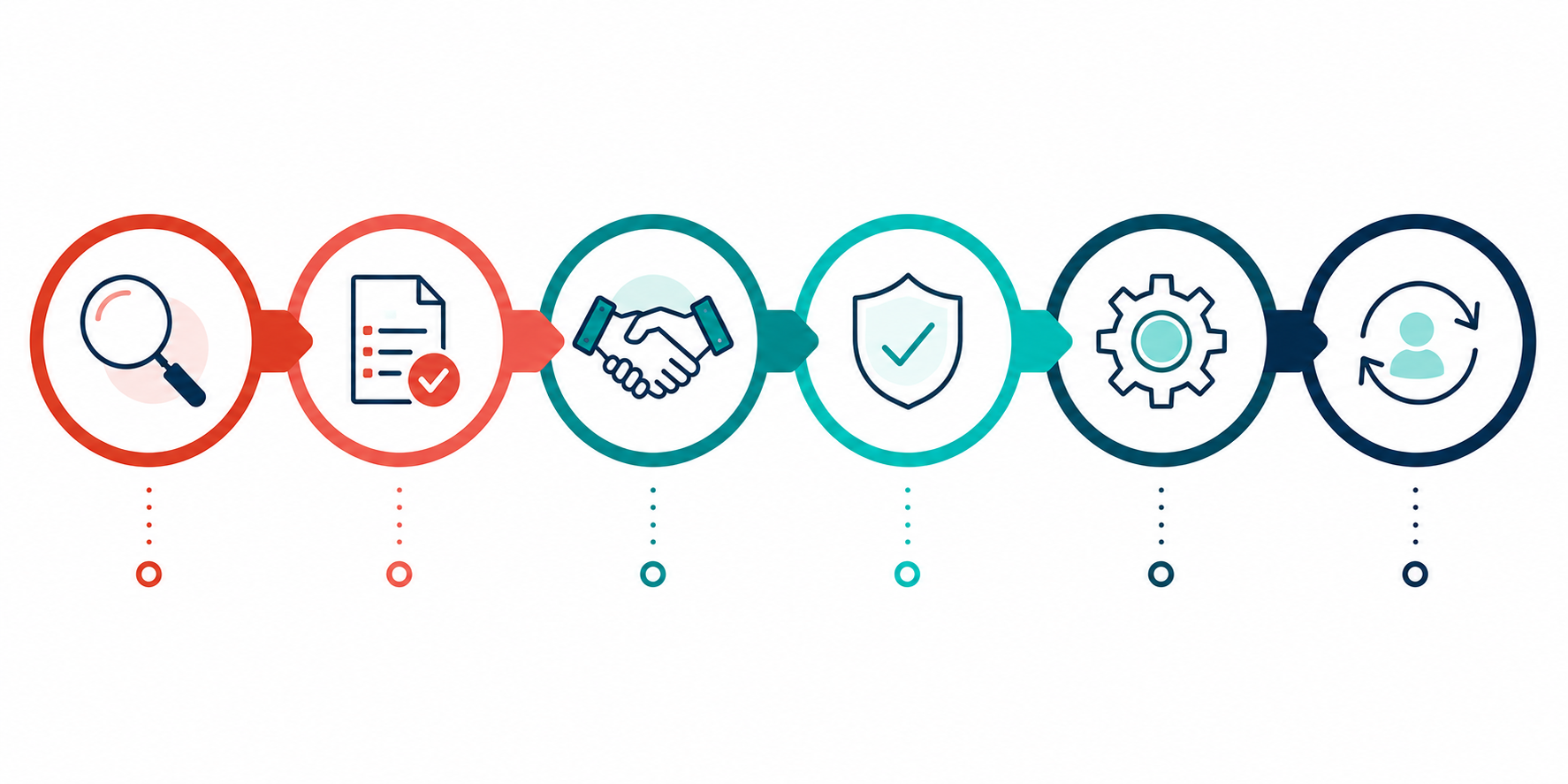
The insurance customer journey moves through six core stages, and each customer takes actions and makes decisions within them, with distinct customer needs, pain points, and agency responsibilities at every step:
1. Awareness — The customer recognizes a need for coverage.
2. Research and quote comparison — The customer actively evaluates options, compares policies, and requests quotes.
3. Policy purchase and onboarding — The customer selects a policy, completes the application, and is onboarded as a new policyholder.
4. Claims processing — The customer files a claim and experiences the agency’s operational response during a high-stakes moment.
5. Policy servicing — The customer manages their active policy — updates, billing, support requests, and changes.
6. Renewal and retention — The customer evaluates their coverage at the end of the policy term and decides whether to renew or seek coverage elsewhere.
“Mapping the customer journey in insurance helps identify pain points and opportunities for improvement, enhancing overall customer satisfaction and loyalty. A well-structured customer journey map allows insurers to pinpoint critical touchpoints and customer emotions, which can lead to better service delivery and increased retention rates.”
Insurance Customer Journey Stages Explained
Stage 1 — Initial Awareness and Research
The insurance customer journey begins before a prospect ever contacts your agency. Awareness is triggered by a life event — purchasing a home or vehicle, losing existing coverage, starting a business, or recognizing a coverage gap — that creates an immediate need.
At this stage, customers:
-
Search online for coverage options using broad terms
-
Visit agency websites and read educational resources
-
Form initial impressions of providers based on digital presence and content quality
-
Begin to define their coverage needs and budget expectations
For agencies, the awareness stage is about being findable and credible. Prospects who find clear, educational content that speaks to their specific situation are far more likely to move into your quote pipeline than those who encounter generic marketing language.
The agencies that win at awareness invest in content that answers real customer questions — what coverage they need, how insurance works for their specific situation, and what to look for in an agency partner.
Stage 2 — Quote Comparison and Decision-Making
Once a prospect has defined their coverage needs, they move into active comparison. This is one of the most competitive stages of the insurance customer journey, and it is where many agencies lose prospects they should have converted as buyers compare policies from different insurance companies.
Customers at this stage are evaluating:
|
Priority |
What the Customer Is Asking |
|---|---|
|
Price |
What will this actually cost me — including all fees? |
|
Coverage |
Does this policy cover what I actually need? |
|
Communication |
How responsive and clear is this agency? |
|
Claims reputation |
What happens when I actually need to make a claim? |
|
Customer support |
Will I be able to reach someone when it matters? |
The agencies that perform best at this stage combine competitive pricing with fast, clear communication and transparent policy explanations. Prospects who have to chase a quote or wait days for a response will simply move on.
At this stage, customers:
-
compare policy options, begin filling out applications, and expect data auto-fill plus educational content that makes choices easier
Insurance agency automation best practices play a critical role here. Agencies using smart quote workflows can respond to quote requests within minutes, deliver personalized comparisons, and follow up automatically — turning inquiry velocity into a genuine competitive advantage.
Stage 3 — Policy Purchase and Onboarding
The moment a prospect chooses your agency, the operational quality of your onboarding process determines whether they become a loyal long-term client or a churned customer twelve months later.
Effective onboarding covers:
-
Clear, accurate policy documentation delivered promptly
-
Billing setup that is simple and transparent
-
A structured welcome workflow that confirms coverage details and sets expectations
-
Personalized communications that make the new client feel known, not processed
-
Automated follow-ups that check in during the first 30 to 90 days
Automated communication can dramatically improve the transition from policy purchase to active policyholder by providing clear next steps and removing the guesswork that often frustrates new clients.
Agencies that treat onboarding as a one-time administrative task — rather than an ongoing relationship-building process — see higher early churn and lower lifetime value from their client base.
Stage 4 — Claims Processing Experience
Claims processing is the moment that defines the entire insurance customer relationship. It is, in many cases, the first significant interaction a policyholder has with their insurer after purchasing a policy — and it happens when the customer is stressed, time-sensitive, and paying close attention to every detail of the experience.
Clients experience the actual value of their policy during claims. How the agency handles this moment — speed of response, clarity of communication, accessibility of support — determines whether the customer stays or leaves.
The most common claims experience failures are:
-
Slow acknowledgment of the initial claim
-
Unclear communication about next steps and timelines
-
Poor accessibility — no mobile options, no self-service status tracking
-
Reactive rather than proactive updates
-
Friction in documentation submission
Processing delays create frustration and increase the risk of customer turnover. Agencies that invest in omnichannel claims communication — combining email, SMS, and self-service portals — consistently outperform those relying on manual, phone-only processes.
According to industry research from Forrester on insurance, timely and omnichannel support during claims is not just a nice customer experience feature — it is a direct retention mechanism.
Stage 5 — Policy Servicing and Customer Support
Between purchase and renewal, the ongoing servicing relationship is where loyalty is built or eroded — quietly, interaction by interaction.
Policy servicing touchpoints include:
-
Policy change requests (coverage updates, endorsements, vehicle changes)
-
Billing updates and payment processing
-
Customer inquiries and support requests
-
Annual policy reviews
-
Cross-sell and upsell conversations
The risk at this stage is the inverse of what most agencies expect. It is not dramatic failures that cause churn — it is the accumulated weight of small frictions. Slow response times, repeated manual re-keying of the same data, no self-service options, and impersonal communications all chip away at customer trust and engagement.
Agencies that invest in optimizing their insurance agency workflow — including self-service portals, AI-driven chat support, and automated communication sequences — allow their agents to focus on high-value conversations rather than routine administrative requests.
Stage 6 — Policy Renewal and Retention
Renewal is where the entire insurance customer journey comes full circle. Policyholders who have had consistently positive experiences across awareness, onboarding, claims, and servicing will renew with minimal persuasion. Policyholders who have experienced friction at any stage will use the renewal moment as their exit point.
Effective renewal and retention strategies include:
-
Automated renewal reminders sent well in advance of the policy end date — not just two weeks out
-
Personalized coverage review conversations that demonstrate the agent understands the client’s situation
-
Retention offers for at-risk clients identified through behavioral signals
-
Customer feedback loops that capture satisfaction signals before the renewal conversation
-
Loyalty recognition that rewards long-term policyholders
The end of a policy term is a key moment where transparent communication about renewal terms, pricing changes, and coverage updates directly determines whether the client stays or shops elsewhere.
Agencies with automated renewal workflows consistently outperform those relying on manual follow-up. The gap is not in the quality of the conversation — it is in whether the conversation happens at all.
Common Insurance Customer Journey Pain Points
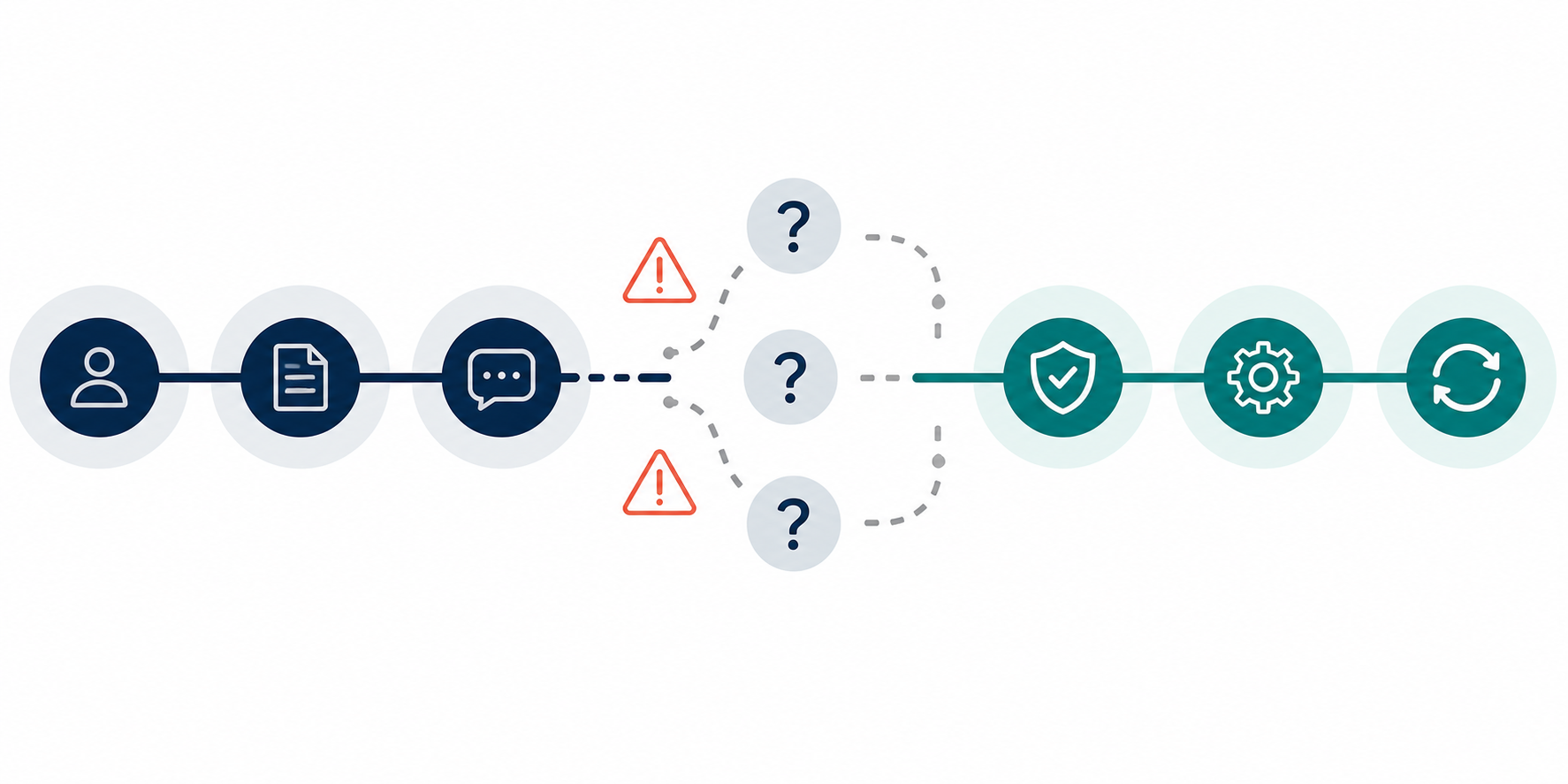
Understanding where the insurance customer journey breaks down is the first step to fixing it. The most common failure patterns are operational, not strategic — and most of them are addressable with the right workflows and systems.
Communication Gaps
Inconsistent communication is the most pervasive pain point across the entire insurance customer journey. Agencies need consistent communication across quote, onboarding, and claims touchpoints, or prospects move on, new clients disengage, and policyholders lose confidence.
Communication gaps are almost always a workflow problem, not a staffing problem. Agencies that automate touchpoints across every journey stage consistently deliver more responsive experiences without adding headcount.
Slow Claims Processing
Slow claims handling is the single most damaging experience a policyholder can have. A simplified claims process can significantly improve customer retention by reducing frustration and increasing satisfaction during the most critical interaction in the entire policy lifecycle.
For independent agencies, speed in claims communication — acknowledgment, status updates, next step guidance — is directly within their control even when claim resolution timelines are set by the carrier.
Manual Agency Workflows
Many insurance agencies are still running core business processes — lead capture, follow-up, quote generation, document management, renewal reminders — on manual systems, spreadsheets, or disconnected software stacks. This creates data duplication, missed touchpoints, and agent burnout.
Manual workflows are not just an operational problem. They are a customer experience problem. Every manual step introduces a delay or inconsistency that the client eventually notices.
Poor Customer Follow-Up
Lead leakage and post-purchase drop-off both trace back to the same root cause: inconsistent follow-up. Prospects who receive an initial quote and then hear nothing within 24 to 48 hours have an extremely low conversion rate. New clients who are not contacted within the first 30 days post-purchase report significantly lower satisfaction and are more likely to churn at renewal.
Lack of Personalized Experiences
Policyholders increasingly expect personalized communication that reflects their specific situation, coverage history, and preferences. Generic mass communications — the same renewal email sent to every client, regardless of their history or risk profile — are a missed opportunity at best and a churn accelerator at worst.
Offering personalized insurance options based on data analytics can enhance the customer experience and increase retention by aligning products with individual policyholder needs. The NAIC Insurance Industry Snapshots consistently show that customer-centric service delivery is one of the strongest drivers of long-term policyholder loyalty across all insurance segments.
|
Customer Pain Point |
Impact on Customer Satisfaction |
Optimization Opportunity |
|---|---|---|
|
No quote follow-up within 48 hours |
High lead leakage, low conversion |
Automated quote follow-up sequence |
|
Poor claims communication |
High churn at renewal |
Omnichannel claims status updates |
|
Manual renewal reminders |
Missed renewals, lost revenue |
Automated renewal alert workflows |
|
Generic impersonal communications |
Low engagement, low loyalty |
CRM segmentation and personalization |
|
Slow response to service requests |
Frustration, loss of trust |
Self-service portals, AI chat support |
How Insurance Agencies Can Improve the Customer Journey

Use Automation to Improve Customer Experience
Automation is the most practical lever independent insurance agencies have for delivering a consistently excellent customer journey without scaling headcount proportionally to client growth.
Done well, it can enhance customer satisfaction by simplifying jargon, automating routine processes, and supporting self-service portals.
The highest-impact insurance agency automation best practices for improving the customer journey include:
-
Automated renewal reminders sent at 90, 60, and 30 days before policy expiry
-
Quote follow-up sequences triggered immediately after a quote request, with timed touchpoints at 24, 48, and 72 hours
-
Welcome workflows for new policyholders confirming coverage details and setting expectations for ongoing communication
-
Lead nurturing sequences for prospects not yet ready to buy
-
Renewal alert workflows for agents flagging at-risk clients based on engagement signals
Proactive communication with policyholders — reminders for renewals or updates during the claims process — can significantly boost customer engagement and retention rates. Automation makes proactive communication reliable rather than dependent on individual agent memory or bandwidth.
Create Personalized Customer Experiences
Personalization in the insurance customer journey does not require enterprise-level technology or data science teams. For independent agencies, it starts with basic CRM segmentation: knowing which clients are in which product lines, where they are in their policy lifecycle, what communication they have received, and how segmentation supports more personalized interactions across the policy lifecycle.
The best CRM for insurance agents enables practical personalization through:
-
Segmented communication workflows by product line (Life, Health, P&C, Commercial)
-
Behavioral triggers that send relevant content based on client actions (or inaction)
-
Coverage review prompts timed to key life events (new vehicle, new property, business expansion)
-
Data-driven renewal conversations that reference the client’s specific coverage history and claims experience
Agencies that use customer segmentation and CRM workflows to deliver relevant, timely communications consistently outperform those sending undifferentiated mass messaging.
Improve Claims Communication
The claims communication gap is one of the most addressable problems in the insurance customer journey — and the one with the highest direct impact on retention.
Effective claims communication includes:
-
Immediate automated acknowledgment when a claim is filed
-
Regular status update messages (not just when there is a resolution)
-
Multi-channel delivery — email and SMS — so clients receive updates on their preferred channel
-
Clear guidance on next steps, documentation requirements, and expected timelines
-
A direct line to a named agent for escalation if needed
Clients should never have to chase their agency for claims status updates. The agency should be reaching out first.
Centralize Customer Data and Workflows
One of the most significant operational constraints for independent insurance agencies is data fragmentation. When client information, policy data, communication history, and task management live across multiple disconnected systems — a CRM, an insurance agency management system, an EDM platform, a document storage tool, a quoting platform — no single agent has a complete picture of the client relationship.
This fragmentation creates duplicate data entry, inconsistent communication, missed follow-ups, and slow response times. It also makes delivering a personalized experience nearly impossible, because no one system holds the complete customer record.
Centralized agency management platforms that integrate the full client lifecycle — from lead capture through policy management, communication, and renewals — remove this fragmentation. Agents spend less time managing systems and more time managing client relationships.
“Continuous monitoring and optimization of the customer journey are essential for adapting to evolving customer expectations and improving service delivery in the insurance industry.”
What Is an Insurance Customer Journey Map?

Insurance Customer Journey Map Definition
An insurance customer journey map is a visual or structured representation of every stage, touchpoint, and interaction a policyholder has with an insurance agency — from initial awareness through renewal. It captures the customer’s goals, emotions, pain points, and actions at each stage, alongside the agency’s operational touchpoints and communication channels.
For insurance agencies, a customer journey map serves two purposes: it makes the customer experience visible — surfacing gaps and friction that are otherwise invisible — and it provides a framework for prioritizing operational improvements.
Customer Journey Mapping Example for Insurance Agencies
A practical insurance agency customer journey map covers:
|
Stage |
Customer Touchpoints |
Agency Touchpoints |
|---|---|---|
|
Awareness |
Google search, website visit, social media |
SEO content, paid ads, landing pages |
|
Quote comparison |
Quote request form, agent conversation |
Automated quote workflow, follow-up sequence |
|
Policy purchase |
Application submission, payment setup |
Welcome email, onboarding workflow, policy documentation |
|
Claims |
Claims filing, status updates, resolution |
Acknowledgment automation, omnichannel updates, agent follow-up |
|
Servicing |
Policy change requests, billing, support |
Self-service portal, CRM records, agent responsiveness |
|
Renewal |
Renewal notice, coverage review, decision |
Automated reminders, personalized retention offer, feedback capture |
Benefits of Customer Journey Mapping Insurance Workflows
Agencies that invest in structured customer journey mapping consistently report:
-
Higher customer retention rates driven by proactive identification of at-risk policyholders
-
Better service delivery through optimized workflows at high-friction touchpoints
-
Reduced churn at renewal by addressing dissatisfaction signals earlier in the policy term
-
Improved operational efficiency as manual bottlenecks are identified and automated
-
Higher customer satisfaction scores across NPS, CSAT, and renewal rate metrics
Monitoring customer satisfaction through touchpoints can help close service gaps and foster brand loyalty — but only if the data is collected, reviewed, and acted on consistently.
Insurance Customer Journey Best Practices

Build Omnichannel Experiences
Modern policyholders expect to interact with their insurance agency across multiple channels — email, SMS, phone, web portal, and mobile — and to receive a consistent experience regardless of which channel they use.
Building an omnichannel experience does not mean being active on every channel simultaneously. It means ensuring that the client’s data and interaction history is consistent and accessible across every channel your agency uses, so no client ever has to repeat themselves or receive contradictory information.
An insurance broker CRM that centralizes communication history across every channel is the operational foundation for a genuine omnichannel policyholder experience.
Simplify the Claims Process
The single most impactful improvement most independent agencies can make to their customer journey is simplifying and accelerating the claims communication process. This means reducing the number of steps a client has to take to file a claim, automating status updates, and ensuring every claims interaction is handled with urgency and transparency.
Simplification here is not about reducing thoroughness — it is about removing unnecessary friction for the client at the moment they need their agency most.
Use Customer Feedback to Improve Service Delivery
Customer feedback is one of the most underutilized resources in independent insurance agencies. Post-claim surveys, renewal satisfaction checks, and annual relationship reviews all generate client feedback that can directly improve the customer journey — but only if there is a structured process for collecting, reviewing, and acting on it.
Agencies that build feedback loops into their operational workflows continuously improve their service delivery over time. Those that do not are flying blind.
Monitor Customer Satisfaction Metrics
Measuring the insurance customer journey requires tracking the right metrics at the right stages. Key satisfaction metrics for insurance agencies include:
| Metric | What It Measures | When to Measure |
|---|---|---|
| NPS (Net Promoter Score) | Overall loyalty and likelihood to recommend | Annually, post-claim |
| CSAT (Customer Satisfaction) | Satisfaction with specific interactions | Post-claim, post-service |
| Retention rate | Percentage of clients renewing each year | Quarterly, annually |
| Claims satisfaction score | Quality of the claims experience | Post-claim resolution |
| Renewal rate | Percentage of policies renewed at term end | At each renewal cycle |
Agencies that track these metrics systematically identify performance gaps far earlier than those relying on anecdotal feedback or raw churn numbers.
Use Mobile-Friendly Customer Experiences
An increasing proportion of insurance interactions now start on mobile — whether that is a quote request, a claims filing, a billing query, or a policy review. Agencies whose client-facing touchpoints are not optimized for mobile are creating unnecessary friction at multiple stages of the customer journey.
Mobile-friendly experiences include responsive web portals, SMS-based communication workflows, mobile apps, and mobile-accessible policy documentation — practical capabilities that are now baseline expectations, not differentiators.
How AGENCYMATE Helps Improve the Insurance Customer Journey

AGENCYMATE was built specifically to solve the operational problems that fragment the insurance customer journey for independent US agencies. It is not a generic CRM adapted for insurance, and it is not an enterprise AMS with features you will never use. It is a single, fully integrated platform designed by agents, for agents — built around the actual workflow of a modern US insurance agency.
Automated Agency Workflows
AGENCYMATE automates the routine tasks that drain agent time, increase engagement throughout the client lifecycle, and create customer experience gaps: quote follow-up sequences, renewal reminder workflows, new client onboarding automations, policy change acknowledgments, and claims communication triggers. Agents spend less time chasing tasks and more time building client relationships.
Customer Communication Automation
Personalized, timely communication is the backbone of a strong insurance customer journey. AGENCYMATE’s communication automation delivers personalized messages across email and other channels at the right moments in the client lifecycle — without requiring agents to manually manage each touchpoint. Every communication is tracked in the client record, so every agent always has the full picture.
CRM and Customer Lifecycle Management
AGENCYMATE’s CRM is purpose-built for the insurance agency workflow. Every lead, prospect, and policyholder moves through a structured lifecycle — from initial capture through quote, bind, onboarding, ongoing servicing, and renewal — with full visibility for agents and agency owners. No more data duplication across disconnected systems. No more missed follow-ups because the task lived in a spreadsheet.
Policy Management and Servicing Tools
Policy management in AGENCYMATE covers the complete policy lifecycle with policy management systems for smart form carrier quotes and comparison, renewals, endorsements, and document management with built-in eSignature, plus advanced billing and financial management. Everything an agent needs to service a client is in one place — accessible from any device, at any time.
Built by Agents, for Agents
AGENCYMATE’s “best mate” positioning is not a tagline. It reflects how the platform was actually designed: by people who understand the day-to-day reality of running a US insurance agency — the administrative load, the compliance requirements, the carrier relationships, the pressure to service more clients without adding more staff.
The result is a platform that genuinely reduces the operational complexity of the insurance customer journey, so agencies can focus on what matters: building lasting relationships and growing their book of business.
If you’re looking for a better way to manage your agency’s customer journey from lead to renewal, explore the AGENCYMATE platform.
Frequently Asked Questions
What is the insurance customer journey?
The insurance customer journey is the complete lifecycle of interactions between a policyholder and their insurance provider — covering every stage from initial awareness and quote comparison through policy purchase, onboarding, claims processing, policy servicing, and renewal. For insurance agencies, actively managing this journey improves customer satisfaction, retention, and long-term agency growth.
Why is customer journey mapping important in insurance?
Customer journey mapping helps insurance agencies identify pain points, communication gaps, and operational inefficiencies at every stage of the policyholder lifecycle. By making the customer experience visible, agencies can prioritize improvements that directly increase retention, reduce churn, and improve customer satisfaction scores.
What are the stages of the insurance customer journey?
The six core stages of the insurance customer journey are: awareness, research and quote comparison, policy purchase and onboarding, claims processing, policy servicing, and renewal and retention. Each stage has distinct customer needs and agency responsibilities.
How can insurance agencies improve customer retention?
Insurance agencies improve customer retention by delivering proactive communication at every journey stage, providing exceptional service across claims, servicing, and renewal touchpoints, simplifying the claims experience, automating renewal reminders, personalizing client interactions based on coverage history, and using customer feedback to identify and resolve service gaps before they trigger cancellation.
How does automation improve the insurance customer experience?
Automation improves the insurance customer experience by ensuring consistent, timely communication at every touchpoint — quote follow-ups, onboarding workflows, claims status updates, renewal reminders — without relying on individual agents to manually manage every interaction. The result is a more responsive, reliable experience for policyholders and a more efficient operation for the agency.
What is an insurance customer journey map?
An insurance customer journey map is a structured representation of every stage, touchpoint, and interaction a policyholder has with an insurance agency — from initial awareness through renewal. It captures customer goals, emotions, pain points, and agency touchpoints at each stage, and is used to identify gaps and prioritize operational improvements.
Why is claims processing important for customer satisfaction?
Claims processing is the moment policyholders experience the actual value of their insurance coverage. How an agency handles the claims experience — speed, transparency, communication quality, and ease of access — directly determines customer satisfaction and renewal intent. Poor claims experiences are one of the leading drivers of churn in the insurance industry.
What tools help improve the insurance customer journey?
The tools that most directly improve the insurance customer journey for independent agencies are integrated agency management platforms that combine CRM, policy management, communication automation, document management, and reporting in a single system, supporting more data driven decisions across the policyholder lifecycle. Agencies that consolidate onto a purpose-built platform like AGENCYMATE eliminate the data fragmentation, manual workflows, and communication gaps that degrade the policyholder experience across disconnected software stacks.
Final Thoughts: Creating a Better Insurance Customer Journey

The insurance customer journey is not a marketing concept. It is the operational reality of every interaction your agency has with every policyholder — from the first Google search to the tenth renewal.
The agencies that win long-term in the US insurance market are not necessarily the ones with the lowest prices or the broadest product range. They are the ones that make every stage of the customer journey easy, responsive, and consistent. Policyholders who feel known, served, and valued by their agency do not shop around at renewal. They refer their colleagues, their family members, and their business partners.
Achieving that standard at scale requires a customer-centric operational mindset and the right technology infrastructure. It requires replacing disconnected, manual workflows with integrated automation that delivers the right communication to the right client at the right moment — without depending on an individual agent to remember every task.
AGENCYMATE was built for exactly this. A single platform replacing the multi-subscription stack, built by agents who understand the real cost of a fragmented customer journey.
Explore the AGENCYMATE platform and see how a mate-like approach to agency management can transform your customer experience from first contact to loyal, long-term policyholder.


ENGAGE
COMMUNICATE WITH YOUR LEADS AND ENGAGE IN ANY CHANNEL TURNING THEM INTO PROSPECTS

CONVERT
OBTAIN AND COMPARE QUOTES, REVIEW AND RECOMMEND OFFERS, CONVERT YOUR PROSPECTS INTO CUSTOMERS

PROSPER
TRANSACT AND DELIVER POLICIES, ARCHIVE ALL CUSTOMER INTERACTIONS HISTORY ENSURING YOU COMPLY AND PROSPER
Proudly Partnering with


WHY SUBSCRIBE TO MULTIPLE SOFTWARE PLATFORMS WHEN YOU ONLY NEED ONE?
Insurance Agencies no longer need a separate CRM, AMS, Email Marketing and eSignature software applications to manage leads and nurture prospects. AGENCYMATE all-in-one platform delivers fast and accurate lead-to-quote-to-sale insurance policy service excellence.
JOIN OUR AGENCYMATE COMMUNITY TODAY
AGENCYMATE is powered by CoTé Software & Solutions – a technology company providing Enterprize Experience Management Software-as-a-Service via its scalable virsaic™ platform, supported by managed services and digital transformation solutions. CoTé Software & Solutions help organizations solve challenges and increase engagement from Customer Experience, Business Experience through to the Employee Experience.
© 2021 CoTé Software and Solutions.


0 Comments